Learn›Mathematics KnowledgeMK›Volume & surface area
Volume and surface area
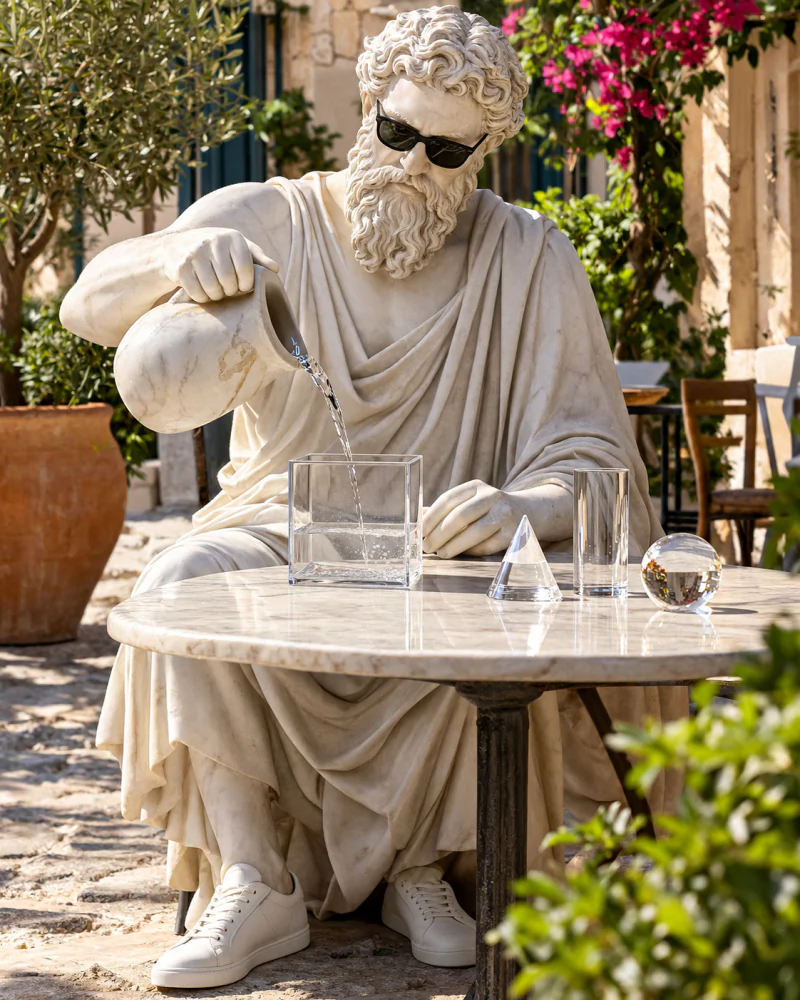
Volume is how much fits inside a solid; surface area is how much wrapping paper covers it. Most solids follow one pattern, base area × height, and the pointed ones take a third of that.
Volume = base area × height
For a box, a cylinder or any shape with the same cross-section all the way up, the volume is the area of the base times the height. Cones and pyramids, which come to a point, hold exactly one third of that.
Volume or surface area?
“How much does it hold,” “fill,” “capacity” mean volume, in cubic units. “Paint,” “wrap,” “cover the outside” mean surface area, in square units.
How to solve them
-
1
Boxes and cubes
A box has six rectangular faces in three matching pairs; a cube has six equal squares.
BoxV = l × w × hSA = 2(lw + lh + wh)CubeV = s³SA = 6s²Next step: CylindersExampleThe 8 × 5 × 4 box: what is its surface area?
- Faces: 8 × 5 = 40, 8 × 4 = 32 and 5 × 4 = 20, two of each.
- 2 × (40 + 32 + 20) = 2 × 92 = 184.
Answer 184 square inches
-
2
Cylinders: a circle times the height
The base of a cylinder is a circle, so its area is πr². Multiply by the height.
V = πr²h
Next step: Cones & pyramidsExampleA can has radius 3 and height 10. What is its volume?
- Base: π × 3² = 9π.
- V = 9π × 10 = 90π, about 282.6.
Answer 90π
-
3
Cones and pyramids: one third of the matching solid
A cone holds one third of the cylinder with the same base and height; a pyramid holds one third of the matching prism.
ConeV = ⅓πr²h⅓ of a cylinderPyramidV = ⅓ × base × h⅓ of a prismNext step: SpheresConeRadius 3, height 10
⅓ × 90π = 30π
Square pyramidBase 6 × 6, height 5
⅓ × 36 × 5 = 60
-
4
Spheres
A sphere has its own formula. Cube the radius first, then multiply by 4/3 and by π.
V = ⁴⁄₃πr³
Next step: Cubic unitsExampleA ball has radius 3. What is its volume?
- r³ = 3 × 3 × 3 = 27.
- 4/3 × 27 = 36, so V = 36π.
Answer 36π
-
5
Cubic units convert cubed
One foot is 12 inches, but one cubic foot is 12 × 12 × 12 = 1,728 cubic inches. One cubic yard is 3 × 3 × 3 = 27 cubic feet.
Next step: Doubling1 cubic yardin cubic feet
3 × 3 × 3 = 27
1 cubic footin cubic inches
12 × 12 × 12 = 1,728
-
6
Double every length: eight times the volume
Multiplying every length by 2 multiplies the surface area by 2 × 2 = 4 and the volume by 2 × 2 × 2 = 8.
Cube, side 2V = 8, SA = 24
Starting point
Cube, side 4V = 64, SA = 96
Volume × 8, surface × 4
4 traps in the answer choices
The test writes its wrong answers on purpose: each one is what you get if you make one of these mistakes.
Squaring instead of cubing
A cube with side 4, volume:
Wrong4² = 16
Right4³ = 64
Forgetting the ⅓ of a cone
A cone with radius 3 and height 10:
Wrong90π
Right30π
The diameter as the radius
A cylinder with diameter 6 and height 10:
Wrong36π × 10 = 360π
Right9π × 10 = 90π
Cubic units converted like plain units
2 cubic yards in cubic feet:
Wrong2 × 3 = 6
Right2 × 27 = 54
5 questions at test level
Pick an answer, then read why. No timer, no account.
A box is 9 cm long, 4 cm wide and 5 cm tall. What is its volume?
Show the answer
C. V = 9 × 4 × 5 = 36 × 5 = 180. 202 is the surface area, and 18 adds the edges. The volume is 180 cubic cm.
A cube has edges of 5 inches. What is its surface area?
Show the answer
C. Six square faces of 5 × 5 = 25: 6 × 25 = 150. 125 is the volume, and 25 is one face. The surface area is 150 square inches.
A cylinder has a radius of 4 and a height of 7. What is its volume? (use π ≈ 3.14)
Show the answer
B. Base: 3.14 × 4² = 50.24. Volume: 50.24 × 7 = 351.68. 1,406.72 uses 8 as the radius (the diameter), and 175.84 multiplies by r instead of r². The volume is 351.68.
A cone has a radius of 6 and a height of 5. What is its volume in terms of π?
Show the answer
B. V = ⅓ × π × 6² × 5 = ⅓ × 180π = 60π. 180π is the cylinder, without the ⅓. The volume is 60π.
How many cubic feet are in 2 cubic yards?
Show the answer
C. One cubic yard is 3 × 3 × 3 = 27 cubic feet, so 2 cubic yards is 54. 6 converts as if it were plain yards, and 18 uses 9. It is 54 cubic feet.
10 flashcards
Tap a card to flip it. Keep the ones you miss until they stick.
All 10 cards known.
You finished volume and surface area.
Practice score: not taken yet Take the practice
Next topic: Composite figuresSee this topic move.
In the course, every topic is drawn step by step on a whiteboard while a voice explains it, with timed practice tests and a plan for your test date. The first lessons of every module are free.
