Learn›Mathematics KnowledgeMK›Circles
Circles
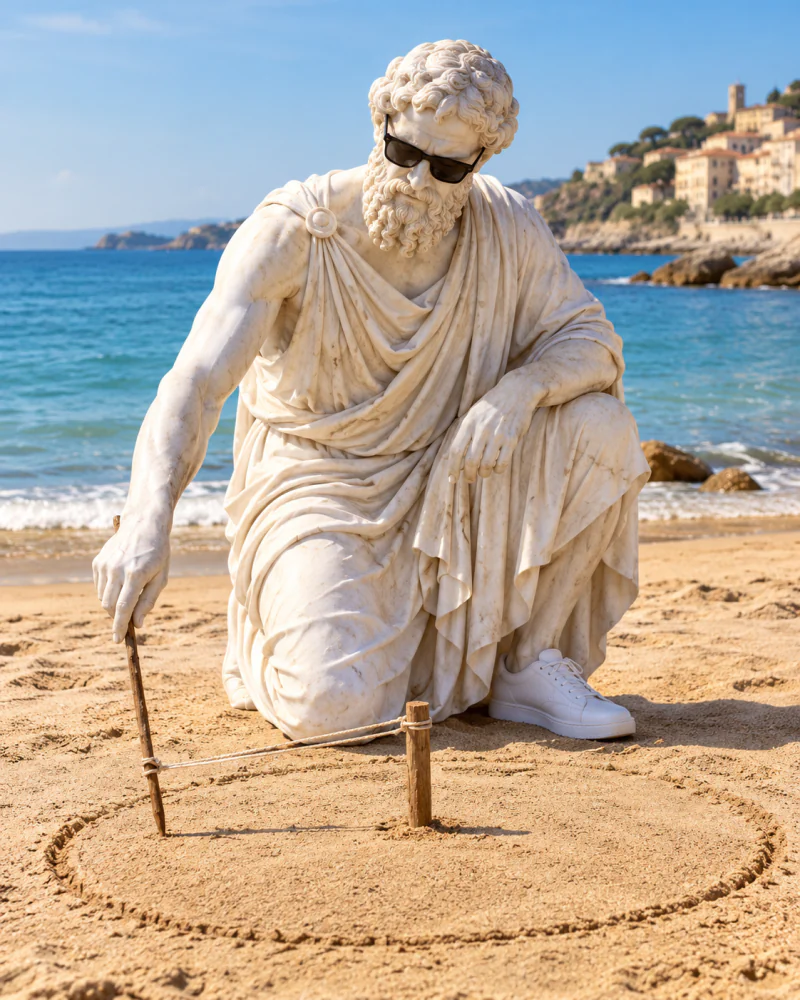
Two formulas cover almost every circle question. The points are lost on one detail: whether the problem gave you the radius or the diameter. Here is how to keep them straight.
Everything starts from the radius
π (pi) is the number of times the diameter fits around the circle: about 3.14, or 22/7. The test tells you which value to use, or wants the answer left “in terms of π,” like 49π.
Radius or diameter? Check twice
Both formulas use the radius. If the problem gives the diameter, halve it first. Using the diameter in A = πr² makes the area four times too big, and that wrong answer is always offered.
How to solve them
-
1
Circumference: the distance around
The circumference is a circle’s perimeter. Use C = 2πr, or C = πd if you have the diameter: they are the same formula.
Next step: AreaExampleA circle has radius 7. What is its circumference? (π ≈ 22/7)
- C = 2 × π × r = 2 × 22/7 × 7.
- The 7s cancel: 2 × 22 = 44.
Answer 44
-
2
Area: π times the radius squared
Square the radius first, then multiply by π. Do not multiply π by r and then square the result.
A = π × r × r
Next step: Given the diameterExampleA circle has radius 7. What is its area? (π ≈ 22/7)
- r² = 7 × 7 = 49.
- A = 22/7 × 49 = 22 × 7 = 154.
Answer 154 square units
-
3
Given the diameter? Halve it first
When the answer can stay in terms of π, there is no need to multiply out: just keep π as a letter.
Next step: Working backwardsExampleA circle has a diameter of 12. Find its area in terms of π.
- r = 12 ÷ 2 = 6.
- A = π × 6² = 36π (about 113.04).
Answer 36π
-
4
From the area back to the radius
If the area is given, divide by π to get r², then take the square root.
Next step: SlicesExampleA circle has an area of 81π. What are its radius and circumference?
- πr² = 81π, so r² = 81 and r = 9.
- C = 2π × 9 = 18π.
Answer r = 9, C = 18π
-
5
A slice of a circle: its angle out of 360°
A sector (a pizza slice) is a fraction of the whole circle: its central angle over 360°. Multiply the whole area, or the whole circumference, by that fraction.
sector = (angle ÷ 360) × πr²
Next step: Which π?ExampleA circle has radius 6. What is the area of a 60° sector?
- 60 ÷ 360 = 1/6 of the circle.
- Whole area: π × 6² = 36π.
- 1/6 of 36π = 6π.
Answer 6π
-
6
Which value of π to use
Use what the question says. If nothing is said, look at the answer choices: if they contain π, leave π in; if they are decimals, use 3.14; if a radius is a multiple of 7, 22/7 makes the arithmetic easy.
Choices with πRadius 5, area
Leave it: 25π
Decimal choicesRadius 5, area
3.14 × 25 = 78.5
Radius 14Area with 22/7
22/7 × 196 = 616
4 traps in the answer choices
The test writes its wrong answers on purpose: each one is what you get if you make one of these mistakes.
The diameter used as the radius
Diameter 16, area:
Wrongπ × 16² = 256π
Rightπ × 8² = 64π
Multiplying by π before squaring
Radius 3, area:
Wrong(π × 3)² = 9π²
Rightπ × 3² = 9π
Circumference and area swapped
Radius 4, circumference:
Wrongπ × 4² = 16π
Right2π × 4 = 8π
A half circle without its straight edge
Perimeter of a semicircle, diameter 20:
Wrong½ × 20π = 10π
Right10π + 20
5 questions at test level
Pick an answer, then read why. No timer, no account.
What is the circumference of a circle with radius 9? (use π ≈ 3.14)
Show the answer
B. C = 2 × 3.14 × 9 = 6.28 × 9 = 56.52. 28.26 forgets the 2, and 254.34 is the area. The circumference is 56.52.
A circle has a diameter of 14 inches. What is its area? (use π ≈ 22/7)
Show the answer
C. The radius is 14 ÷ 2 = 7. A = 22/7 × 7 × 7 = 22 × 7 = 154. 616 uses 14 as the radius, and 44 is the circumference. The area is 154 square inches.
The area of a circle is 64π. What is its diameter?
Show the answer
A. r² = 64, so r = 8, and the diameter is 2 × 8 = 16. 32 doubles 16 again, and 64 is r², not d. The diameter is 16.
A pizza with a radius of 10 inches is cut into 8 equal slices. What is the area of one slice? (use π ≈ 3.14)
Show the answer
C. Whole pizza: 3.14 × 10² = 314 square inches. One slice is 1/8 of it: 314 ÷ 8 = 39.25. 7.85 divides the circumference (62.8) instead of the area, and 78.5 is two slices. One slice is 39.25 square inches.
A circular track has a diameter of 70 meters. How far is one lap? (use π ≈ 22/7)
Show the answer
B. One lap is the circumference: C = πd = 22/7 × 70 = 22 × 10 = 220. 3,850 is the area inside the track, and 440 uses 70 as the radius. One lap is 220 meters.
12 flashcards
Tap a card to flip it. Keep the ones you miss until they stick.
All 12 cards known.
You finished circles.
Practice score: not taken yet Take the practice
Next topic: Pythagorean theoremSee this topic move.
In the course, every topic is drawn step by step on a whiteboard while a voice explains it, with timed practice tests and a plan for your test date. The first lessons of every module are free.
