What Is the AFQT?
The AFQT (Armed Forces Qualification Test) is the score that decides whether you qualify to enlist in any branch of the U.S. Armed Forces. It isn't a separate test — it's a calculation pulled from four of the ASVAB sections, and it's the first number a recruiter looks at, before anything else.
If your AFQT doesn't clear the minimum for the branch you want, it doesn't matter how well you did on the rest of the test — you don't qualify. That's why it's the first thing to understand before you study anything else.
How the AFQT Is Calculated
The AFQT uses four ASVAB sections, with this formula:
AFQT = 2 × VE + AR + MK- VE (Verbal Expression): the sum of Word Knowledge (vocabulary) and Paragraph Comprehension (reading comprehension), converted into a single score.
- AR (Arithmetic Reasoning): word-problem math — you have to read and interpret the problem before you can solve it.
- MK (Mathematics Knowledge): algebra, geometry, and straight math concepts, without the word-problem wrapper.
Notice that VE counts twice. That's not a small detail — it means half of your AFQT depends on how well you handle written English, not on math. If reading comprehension is your weak spot, that's the section to attack first — not because it's the hardest, but because it carries double the weight.
The AFQT Isn't an "Out of 100" Score
The result is reported as a percentile, from 1 to 99. An AFQT of 65 doesn't mean "65% of questions right" — it means you scored better than 65% of a national reference sample (18-to-23-year-olds who took the same test in a 1997 study, still used as the comparison baseline). It's a relative measure, not an absolute one.
That's why two people with the same number of correct answers can end up with different percentiles if they took different versions of the test — the modern ASVAB is adaptive (CAT), so question difficulty factors into the score too.
What Score You Need
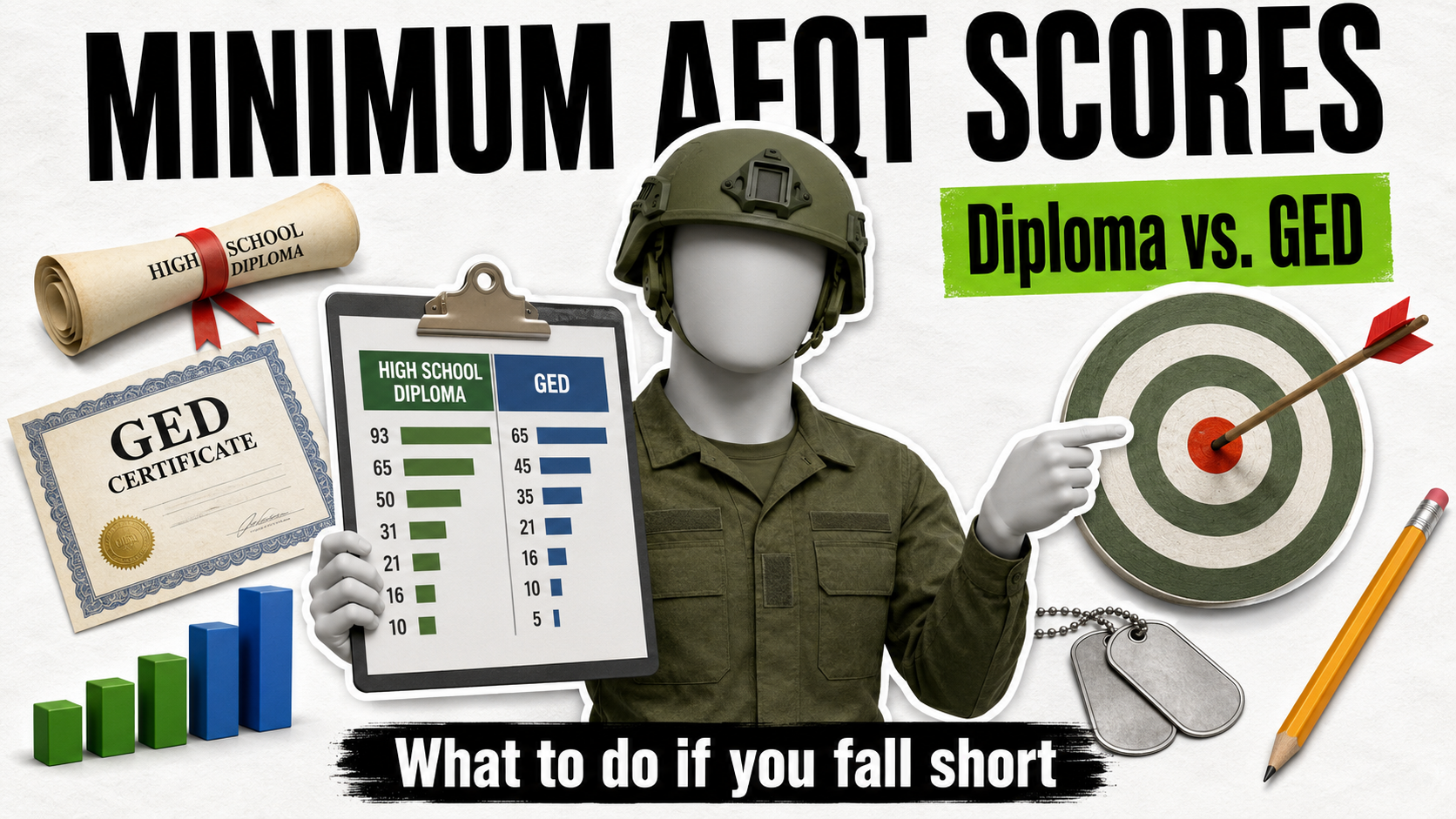
Each branch sets its own AFQT minimum, and it changes depending on whether you have a high school diploma or a GED. Minimums shift occasionally based on each branch's recruiting needs — confirm the exact number with your recruiter before test day, but as a reference:
| Branch | Minimum (diploma) | Minimum (GED) |
|---|---|---|
| Army | 31 | 50 |
| Navy | 35 | 50 |
| Marine Corps | 32 | 50 |
| Air Force | 36 | 65 |
| Space Force | 36 | 65 |
| Coast Guard | 40 | 50 |
A minimum AFQT makes you eligible — it doesn't guarantee the job you want. More technical roles (electronics, cybersecurity, intelligence) require line scores well above the entry minimum.
Where to Start Studying
If your AFQT is far from the minimum you need, the highest-return order is: Word Knowledge and Paragraph Comprehension first (because they count double), then Arithmetic Reasoning (because it mixes reading and math), and Mathematics Knowledge last.
ASVABIFY is built in exactly that order — a reverse-engineered ASVAB prep course, with the adaptive-test engine explained step by step and a study plan built to prioritize the sections that move your score the most.